


Building in public in the age of AI: a practitioner’s thesis on channels, tribes and the tools that make it sustainable
I want to start with a disclaimer, because it matters for everything that follows. What you are about to read is not a scientific study. Nobody ran a controlled experiment. It is a thesis built from my own practice: ten years spent full time in technology, first deep in crypto from 2016 and, for the last few years, deep in AI. It is what I see working, what I see failing, and what I have tested on my own products in front of a live audience.
I am writing it for my community: my students on the Chasing Jarvis and Vanguard MBA programmes, the people who follow my work, and anyone who is about to build a digital product with the help of AI. The world you are building into has changed. If this piece helps you navigate it a little faster than I did, it has done its job.
Here is the thesis in one paragraph. If you build an app or a digital product with AI agents, your distribution starts on the day you start building, not on the day you launch. You build in public: you announce what you are making, you show the work as it happens, you publish every release and you write about what you learned. In return you gather a tribe before you need one, early adopters who give you the feedback you cannot build without and who later become your ambassadors. And at the centre of all of it is not your company logo. It is you.
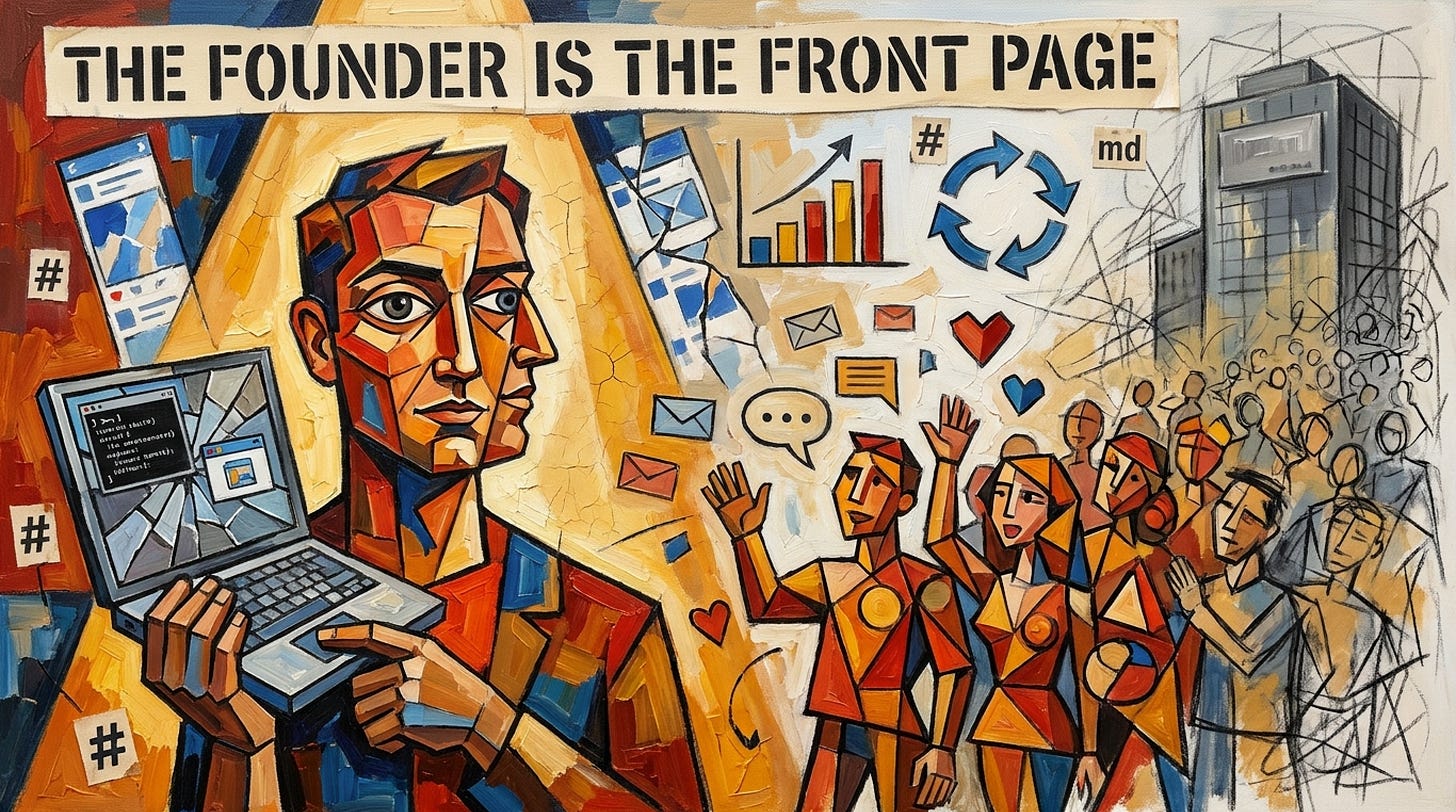
Many things changed in the last few years, some of them because of AI and some of them long before it. The biggest shift, in my view, is this: the founder, as a person, is now in the centre, not the company.
People want to follow people. They want to learn from founders who are building, especially successful ones, and they trust them far more than they trust corporate marketing material. A press release tells you what a company wants you to believe. A founder posting a screenshot of a failed deploy at eleven at night tells you what is actually happening. Audiences learned to tell the difference, and they choose the second one.
As far as I can see, this started with crypto, roughly eight years ago. In crypto the founders became the stars, especially the technical founders. Vitalik Buterin is the obvious example: a builder whose writing, thinking and public reasoning carried an entire ecosystem. Around him, and around many other people making real contributions to the space, a new culture formed. You did not follow the foundation. You followed the person. Call it the cult of the founder, if you like. I would rather call it the return of personal accountability.
That culture then spread to other industries. And it found its home on one platform. We used to say Crypto Twitter. Today people say AI Twitter, or AI X. It is where founders meet, where the conversation happens in real time, where the action is. If you want to work in this space, you need to be part of that conversation. If you are not part of the conversation, then, for this space, you simply do not exist.
Let me be honest about the playing field, because it is not level. Some people have an enormous head start. They started earlier and already have a community around them. They are well-known tech founders, funded by famous VCs, backed by the frontier labs or working inside them. People follow them, partly to learn and partly for their own benefit: being close to the centre has value. That advantage is real, and pretending otherwise would be dishonest.
But then there are stories like Peter Steinberger’s. He is a exceptional software engineer with a successful career behind him (he built PSPDFKit, a PDF toolkit for developers), but his new project, OpenClaw, had no lab and no fund behind it. It was a fully independent, fully open-source project, and he built it live, in public. It became one of the fastest-growing repositories in GitHub’s history, and he has since joined OpenAI.
If you have a good idea and you invest the time to engage, converse and communicate, X gives back. It just takes time. And when it turns, the reach can be truly unbelievable, sometimes overnight.
That is the same approach I have taken with The Curator and AgentLink, and it is the approach this thesis describes. Some people have advantages. But a good product, built openly, with a founder who shows up every day, can still break through. There is a lot of work involved. There is no way around that.
The classic sequence is build, then launch, then go and look for users. Building in public reverses it: you look for your people while you build. By launch day you already have a following that knows what you are making and why, early adopters who tried the pre-alpha and told you what broke, and your first ambassadors: early adopters who liked it enough to talk about it for you. Tribe before launch has been a principle in every one of my campaigns this year.
Without feedback it is very hard to build anything worth using. People tell you what works, what does not, what is confusing, what they expected and did not find. In the earliest stage of a product that feedback is worth more than any feature you could add alone. Building in public is the cheapest feedback loop there is: you publish, people respond, you adjust, you publish again.
Open source is the natural fit, because the repository itself is public proof. The Curator and AgentLink are both open source under the MIT licence, and both were built this way. But closed products work too: you share the journey, the decisions, screenshots and results, just not the code. Lumina is a closed commercial product, and its Gen-2 rebuild was shared openly as a build story, gaps included.
Every post about what you build is also a post about who you are. When AI makes building cheap, the scarce asset becomes trust in a person: someone who knows the domain, ships, and tells the truth about it. That asset stays with you across products, companies and careers. The following I built around The Curator also listens when I release AgentLink.
If you remember one thing from this article, make it this one. Do not push. You cannot push, push, push your own agenda. You contribute first, and when you finally have something to announce, people will listen.
It is exactly the same as in life. Think of a conference or a business meeting. Someone comes up to you, clearly desperate, trying to sell you whatever they are building. It does not land. Now think of a person who has contributed real knowledge to your field, who has helped you, who has added something to your own work. When that person tells you about their new product, you listen. You probably even try it.
X works the same way. Accounts that aggressively push their products get filtered out. Nobody wants that. And it is, in my experience, the most common mistake on LinkedIn: someone gets you to accept a connection request, and the next morning your inbox is full of their pitch. I have tried, calmly, to explain to some of these people why this does not work. Most do not care. They have a script, and some of them are probably paid to run it.
So we need to draw a clear line between deception and healthy promotion. Deception is pretending to be interested in someone so you can sell to them. Healthy promotion is showing real work, honestly, to people who may benefit from it, and letting them decide. You never want to be on the wrong side of that line.
And underneath all of it sits the product. If you build something with no real value, no amount of posting will save it, and we all know how those stories end. If you build something that genuinely helps people and you propose it honestly, people will listen and use it. Building in public is a distribution method. It is not a substitute for value.
Building in public is not one launch post. It is a loop that repeats with every release:
1. Announce. Say what you are starting and why. Gather interest.
2. Show the work. Share real work as it happens: screenshots, short screen recordings, the repository, a decision you made.
3. Engage. Reply, comment, answer questions, be present where your people already talk.
4. Collect feedback. Early users test, complain, suggest. Write it down.
5. Release. Ship the next version and announce it. Every release is a reason to post.
6. Write. Turn what you learned into an article: the story, the method, the mistakes.
7. Back to building, now with more people watching and more feedback coming in.
At the centre of the loop sits the tribe: followers become early adopters, early adopters become ambassadors.
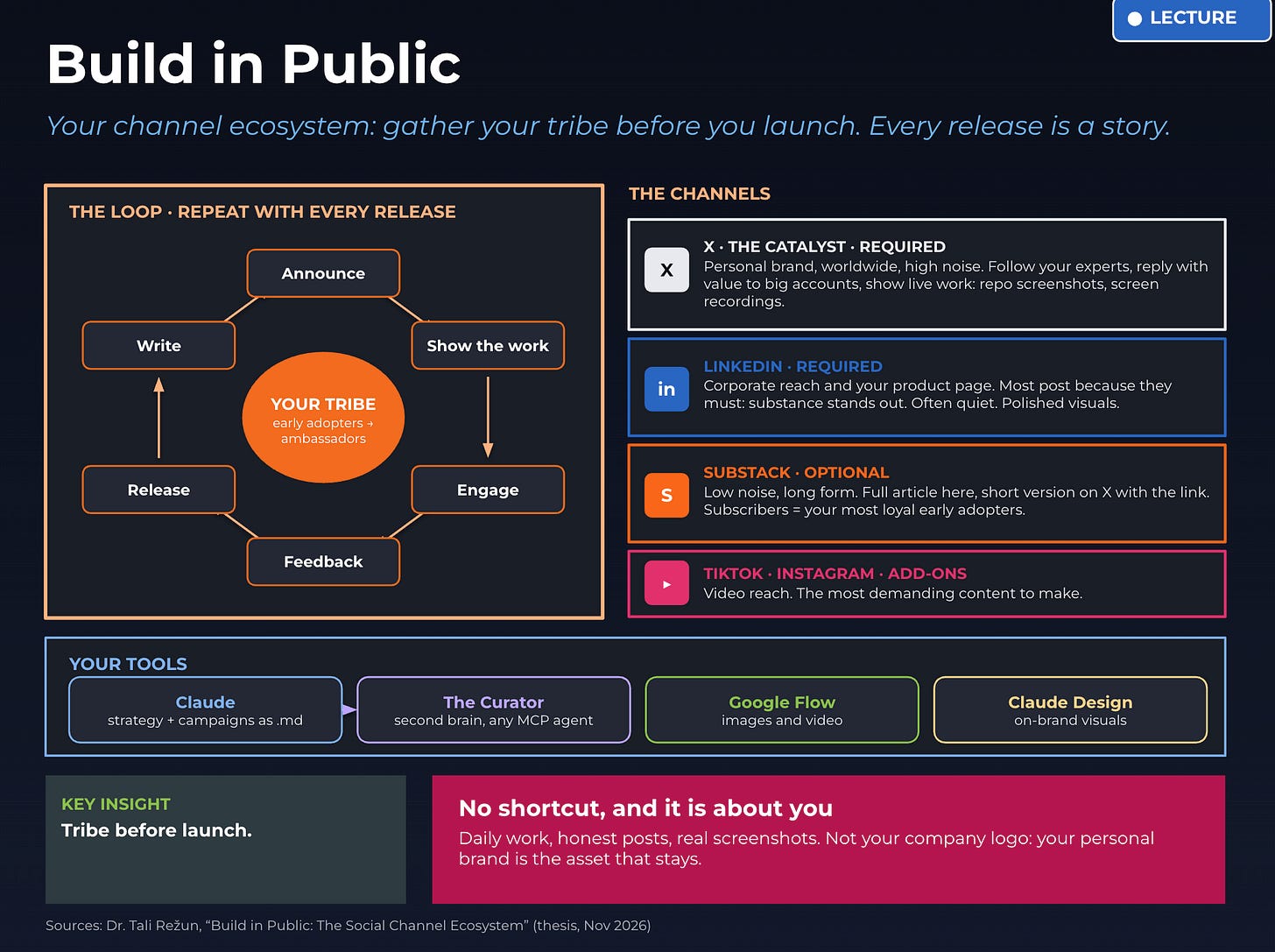
For every release or article I run the same five beats. First, I announce on all my personal channels, each with its own angle. Second, I distribute a condensed version; on X that is the short form of the article with a link to the full piece. Third, a brand-channel echo: the product’s own accounts repeat it as product proof (what it does), not as founder story. Fourth, a builder beat: a technical angle for builders, covering how it was built, with which tools and which method. Fifth, I sustain the topic over the following two weeks with follow-up posts and pull-quotes.
The posts that build the most trust are the honest ones: admitting what did not work, which deploy failed silently, which gap existed until a certain date. In the Lumina Gen-2 campaign, admitting past gaps (data residency, silent deploy failures) was exactly what made the new compliance claims believable. Build in public means the messy parts too. Verify every fact before you post it, and when someone asks a technical question you cannot answer yet, say so.
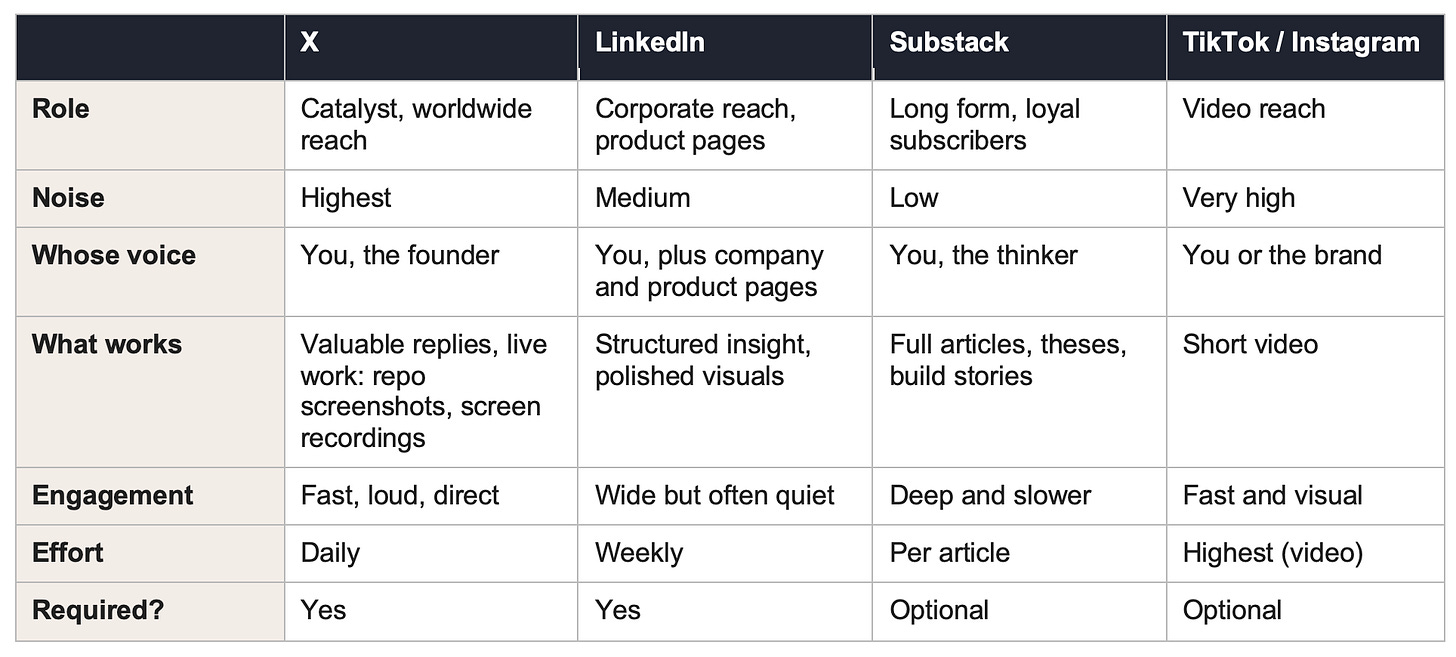
For a product with a worldwide audience, X is the most important channel, and it can be the main catalyst of a product’s success. It is an engagement platform and a personal brand channel: people follow people, not logos. You cannot hide behind a company account. You can connect your profile to your company and product, but X is about you, as a founder and as a builder.
X also has more noise than any other platform, and you need to get used to that. Of all the networks, it is where people are most aggressive. My advice is simple: block, mute and move on, without guilt. You are building your own circle, your own community of people you want to talk to. And once that circle forms, X becomes genuinely enjoyable. I have had wonderful conversations with very well-known people and with people who are only starting out, all of them strangers until a reply turned into a thread.
How I practise it:
1. Find your X tribe first. Follow the people who are the real experts in your domain. You see what they post, you learn what lands, and you get material to respond to.
2. Be an expert, and present yourself as one. Pick your domain and stay in it. Your profile, posts and replies should all say the same thing about what you know.
3. Reply with value to bigger accounts. The accounts with the largest followings carry the most engagement. A reply that adds something (what is missing, a counter-example, a result from your own work) adds value to the whole domain, and you get rewarded with attention. Not “great post”. Substance.
4. Post your own standalone posts. Once people know you from your replies, your own posts start getting answers. This is where you announce, show and release.
5. Reflect your work in near real time. A screenshot of your repository, a short recording of the app under test, a terminal output, a graph from your second brain. It does not need polish. It needs to be real.
My own conventions on X: a terse voice, no hashtags, the link placed deliberately (often in a follow-up reply rather than in the main post), and a reusable reply template for the most common question, “what are you building?”, so I can answer quickly and consistently.
LinkedIn is a corporate channel, and most people on it post because they must: their employer asks them to. That is exactly the opportunity. With so much obligatory content, anyone who brings real substance stands out quickly, and a following grows relatively easily.
The trade-off is that your LinkedIn community can be quiet. People read, but they comment and share less than on X. Still, the word gets out, and it reaches decision makers, buyers and partners who are not on X at all. LinkedIn is also a must for the product itself: a company page and a product page are part of being taken seriously. The tone is more formal, the visuals polished (a clean product visual, a diagram, a professional photo), and my posts are structured with short arrow-bullet points. The brand pages carry product proof; my personal profile carries the founder narrative.
Substack is for knowledge work: writers, researchers and builders who think in long form. Where X is the loudest room, Substack is the quietest, and many people who are active on X also publish there. Use it if your product needs explanation. The pattern is simple: write the full article on Substack (I mirror mine on Medium), post a short version on X with a link, and let interested readers follow the link and subscribe. Subscribers are your most loyal following. They chose to receive your thinking in their inbox, which makes them, almost by definition, your future early adopters.
TikTok and Instagram are valuable, especially for consumer and lifestyle businesses, but they demand the most complex content to produce: video, constantly. For most people building apps and digital products they are an addition once X, LinkedIn and optionally Substack are running. In my own practice, Telegram (for my builder audience and students), Facebook (for the Slovenian community, in Slovenian) and YouTube (for product videos) play supporting roles. Same rule everywhere: each channel gets its own angle of the same story.
The channels at a glance
A thesis about building in public should practise what it preaches, so here are my own numbers, small ones included.
For years my X account was close to dormant. Around the middle of June 2026 I started engaging every day, mostly through replies. Over the last twelve months the account collected about 245,000 impressions, around 5,000 engagements, 917 replies and 712 profile visits, and it now sits at roughly 1,800 followers. Look at the chart and you can see the exact week the daily work started: before it, a flat line; after it, a different account. Nothing about the products changed in that week. Only my presence did.
Two more observations surprised even me.
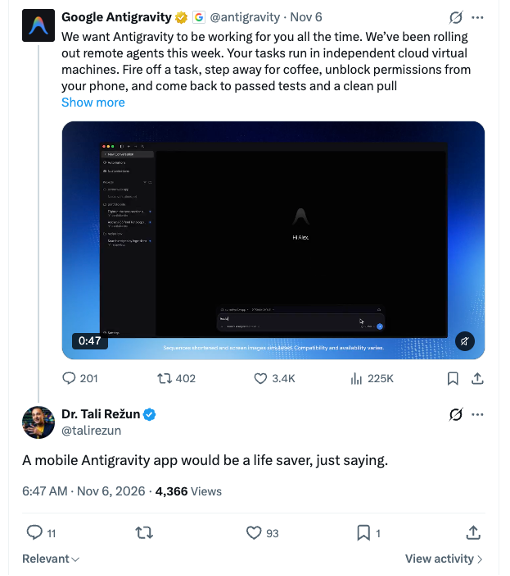
Replies to big accounts out-reach my own posts. A one-line reply under Google’s Antigravity announcement (”A mobile Antigravity app would be a life saver, just saying”) reached more than 4,300 views and 93 likes.
But my own product posts carry the deepest engagement. The AgentLink repository announcement reached 660 views, yet it drew 11 replies and 13 likes, which means real conversations with builders. A post about two AI agents planning a ski holiday reached 566 impressions with an engagement rate of 11.8 percent, against an account average of 2 percent. Fewer people, but the right people, and they talk back. That is what a tribe looks like in its early months: not big, but close.

A product post: 566 impressions, 14 replies, 11.8% engagement rate.
The lesson is the golden rule again, now in data. Replies are how strangers find you. Your own posts are where the people who found you stay.
Building in public is not only a marketing method. It is tied to how digital products are increasingly built and monetised, and I want to show you how I think about it with The Curator, because the two cannot really be separated.
Crypto pioneered a model that I find very instructive (it may well be older than crypto, and I am not an expert on product theory). The project is an open-source repository. You can use it, fork it, change it, do whatever you want with it. But if you use the version run by the founders, you get the support, the app, the hosted services, and for that you contribute: you pay.
The Curator follows a version of this today. It is fully open source and free. It runs as a desktop app on Mac and as a local server on Windows and Linux. Users bring their own API keys from any supported provider (Google Gemini, Anthropic or OpenRouter) and have a fully working second brain. The software costs nothing; the only cost is the model usage you choose. Why give it away? Because right now this is about building a community that trusts me. Trust comes first; monetisation can only follow it.
What might come later, and I say this as a direction I am considering, not a promise: an enterprise edition of The Curator for companies building shared brains and company brains, monetised in a way that fits that market. And possibly an optional model router: a small subscription that picks good models at a low price to power The Curator, so users do not have to manage keys at all. For individuals building a second brain, or for anyone using The Curator as memory for their agents, it stays open source and free. Whether to use my router or their own Gemini, Anthropic or OpenRouter key will always be the user’s choice.
Open where it builds trust, paid where it saves time, and always the user’s choice. That is the direction I see apps being built today.
This is why building in public and an open product model fit together so well. The open repository is proof of work. The public build story is proof of character. Together they earn the trust that a paid tier later depends on.
Building in public on four or five channels, every day, would be impossible for one person without help. AI is what makes it sustainable. Here is my toolchain, and how you can use the same pattern.
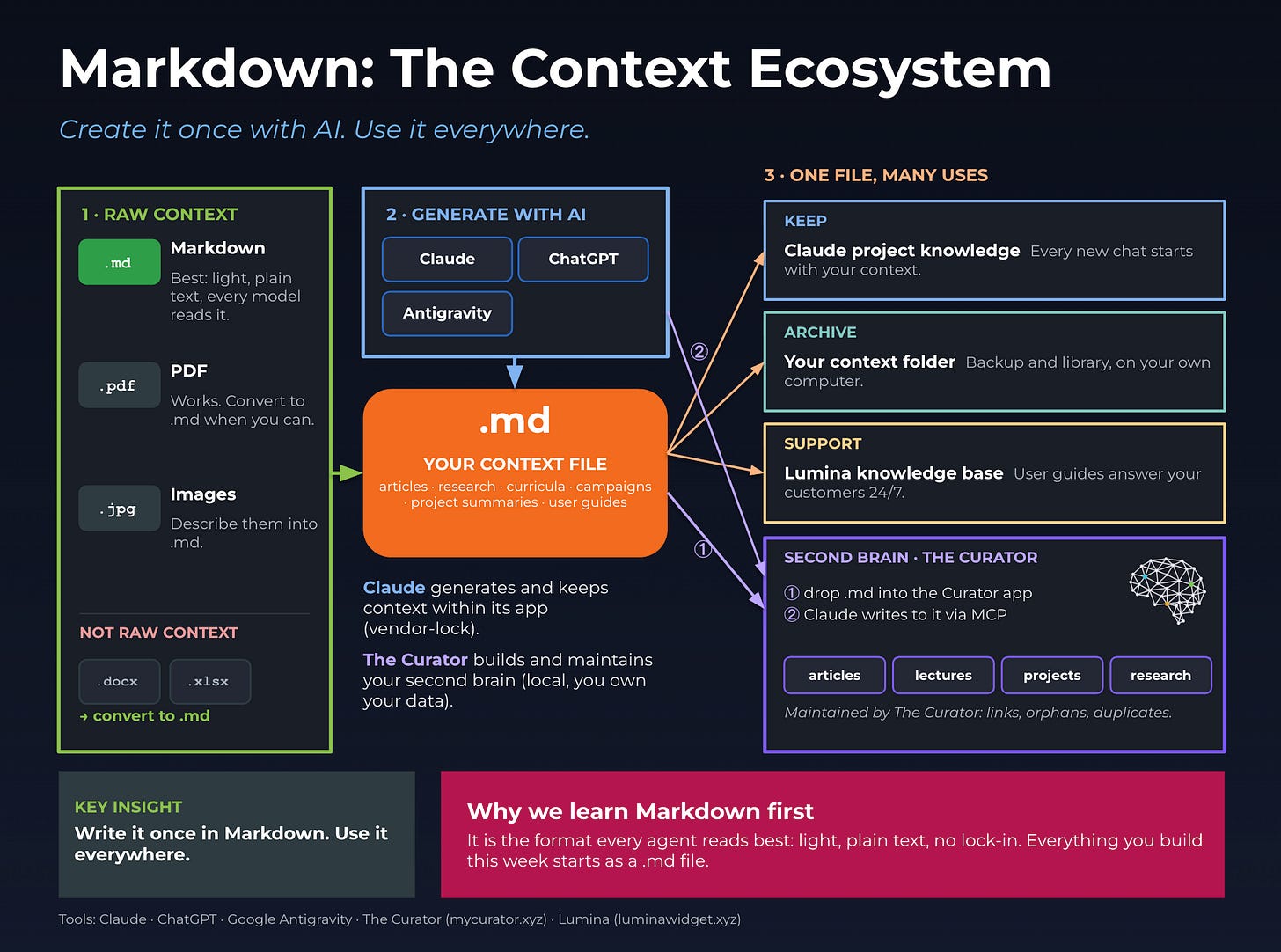
I build my overall brand strategy with Claude, and for every release and every article I create a campaign package with it: the angle per channel, the post texts, the image prompts, the timing. Each package is saved as a Markdown file. How to start: open a Claude project for your product, write your positioning with it (who you are, what you build, for whom, what you will never claim), and save it as a file such as `brand-positioning.md`. Every future campaign starts from that file.
Every campaign, every engagement session log and every positioning note goes into The Curator, my open-source second brain, in its own posts domain. Today that domain holds 57 sources (campaigns and engagement logs) which The Curator compiled into 817 linked wiki pages. Because it is plain Markdown on my own machine, I am not locked into one vendor: any agent that supports MCP (Claude, Codex, OpenCode, LM Studio and others) can read it. The next campaign starts from everything I have already said, promised, released and learned. Context compounds. This article, in fact, was drafted with my posts, projects and lectures domains as context. How to start: install The Curator from mycurator.xyz, create a posts domain, and drop every campaign file into it.
I use Google Flow (Gemini) for images and short videos, and Claude Design to keep design systems from which I draw on-brand visuals. Each project gets a consistent visual identity, for example a recurring illustration style for The Curator campaigns and technical pencil-on-drafting-paper videos for AgentLink. Let AI advise you on the channel, too: on X, real and hands-on (screenshots of the repository, the app, a test run, short screen recordings); on LinkedIn, corporate (a clean product visual, a diagram, a professional image); on Substack, a header image that matches the article’s idea.
My engagement sessions are screenshot-driven. I capture the post I want to respond to, think it through with Claude (with my second brain as context), and post a reply in my own voice. In one session, from 22 July to 2 August 2026, that meant around 86 replies plus six multi-channel campaign packages. The AI helps me be faster, consistent and factually right; it checks claims before I post them. But the opinions, the expertise and the decision to post are mine. An account that is run by AI, rather than with AI, is exactly the kind of noise people learn to filter out.
X analytics, LinkedIn analytics and Substack’s dashboard are enough at the start. Watch replies, profile visits, bookmarks and subscribers more than impressions. Then log what you learn into the second brain too, so your next campaign knows what worked last time.
1. Define your domain and positioning with Claude. Save it as Markdown.
2. Create or clean up your X and LinkedIn profiles; make a page for your product on LinkedIn.
3. Find your X tribe: follow 30 to 50 real experts in your domain.
4. Engage daily: valuable replies to bigger accounts. No pitching.
5. Announce what you are building, once, simply.
6. Share the work as it happens: one screenshot or short recording a day.
7. Release, and run the five-beat campaign across your channels.
8. Write the long version on Substack; post the short version on X with a link.
9. Reply to everyone who tried your product. Write their feedback down.
10. Log every campaign and engagement session as Markdown and feed it into your second brain. Next release: start from there, not from zero.
I want to end where the lecture ends. It is a lot of work: daily engagement on X, weekly on LinkedIn, an article whenever you have something real to say. It is personal: you show your face, your opinions and your mistakes. It takes months, not days; followers come from consistent value, not from one viral post. AI makes it sustainable, because strategy, drafts, visuals and memory are all faster with it. But AI cannot be the expert for you, and it cannot show up for you.
• Start building in public on day one.
• X first, LinkedIn second, Substack when you have long-form ideas.
• Follow before you post. Comment before you broadcast.
• Add value in every reply. No empty praise, and never a pitch in someone’s inbox.
• Show the real work; screenshots beat stock images on X.
• Every release is a post. Every lesson is an article.
• Be honest about what does not work yet.
• Your personal brand carries the story; the product page carries the proof.
• Every campaign and engagement log goes into your second brain as Markdown.
• Treat your early adopters like partners. They become your ambassadors.
The founder is now the front page of the product. That can feel like pressure, and some days it is. But it is also the most democratic distribution channel we have ever had: no budget required, no gatekeeper, only work, honesty and time. If you are building something that genuinely helps people, start showing it today. Your tribe is already out there, waiting for someone to add value to their day.
Dr. Tali Režun is Vice Dean of Frontier Technologies at COTRUGLI Business School and a serial entrepreneur building with AI agents. He builds The Curator and AgentLink in public. Follow the work on X at @talirezun and at talirezun.com.
Originally published on Substack and Medium; a summary is on talirezun.com.
By Dr. Tali Režun · From Lab to Life · Essay · 8 November 2026